Every year, over 77 million Indians are diagnosed with type 2 diabetes. A large chunk of them had no idea they were at risk — and a significant number had BMI numbers that looked perfectly fine on a standard chart. That's the problem with using the wrong reference point.
This guide explains what BMI actually means, why the standard global chart misleads Indians specifically, and what numbers you should actually be tracking.
What BMI Measures — And What It Doesn't
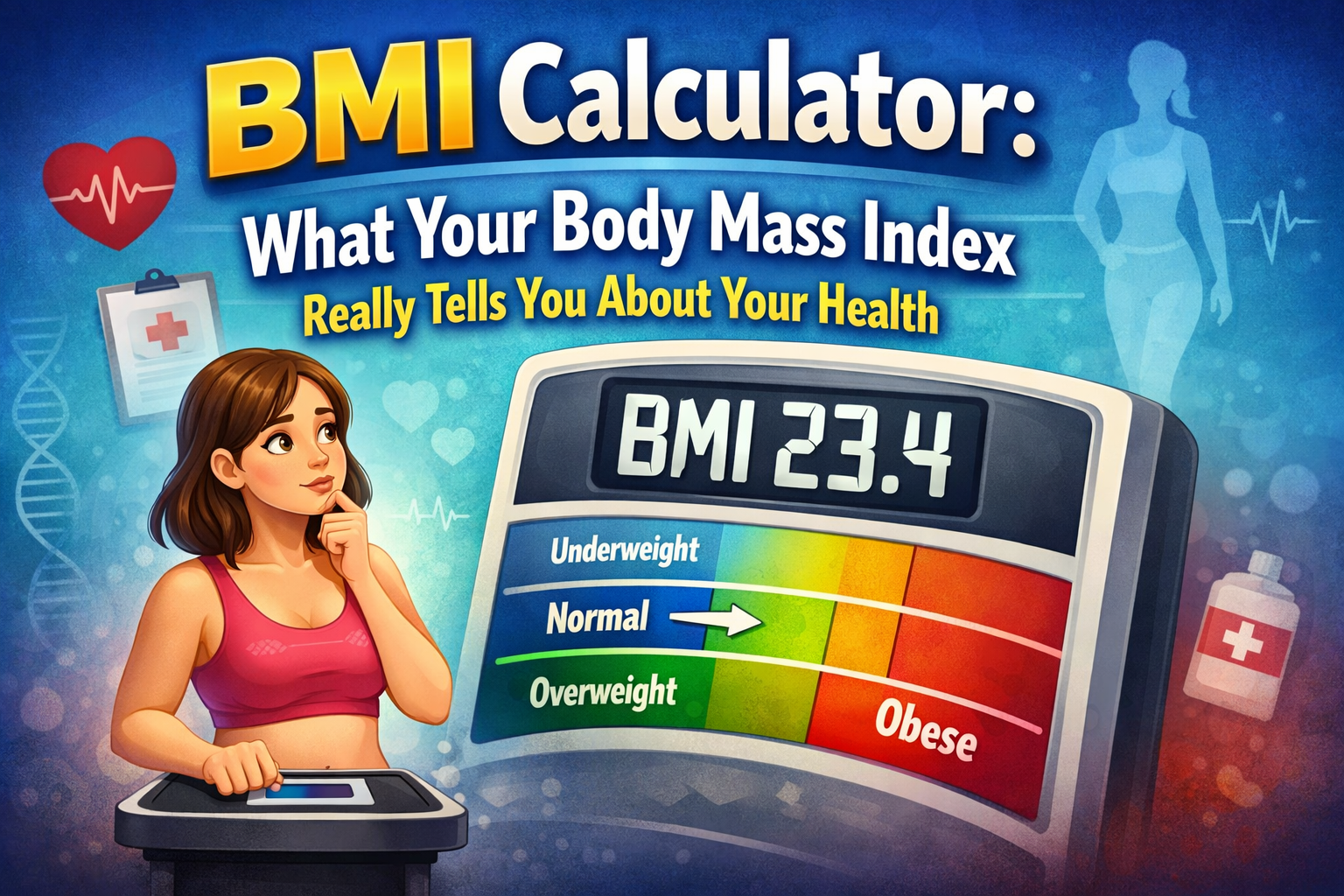
BMI — Body Mass Index — is a simple ratio of your weight in kilograms divided by the square of your height in metres. One number, calculated in seconds, used by doctors worldwide as a first-pass screening tool for weight-related health risk.
It doesn't measure fat directly. It doesn't distinguish muscle from fat. It doesn't tell you where the fat sits in your body. What it does is give a quick, cost-free signal that something may need a closer look — which is why it's still the most widely used metric in clinical settings despite its limitations.
BMI = Weight (kg) ÷ Height² (m²)
Example: Weight 70 kg, Height 1.70 m
BMI = 70 ÷ (1.70 × 1.70) = 70 ÷ 2.89 = 24.2
Use our BMI calculator to get your number instantly — no manual math needed.
The Standard BMI Categories (WHO)
The World Health Organization classifies BMI for adults as follows:
Below 18.5 — Underweight. May indicate nutritional deficiency, thyroid dysfunction, or other underlying conditions.
18.5 to 24.9 — Normal weight. Generally healthy range for most adults globally.
25.0 to 29.9 — Overweight. Increased risk of metabolic conditions if other risk factors are present.
30 and above — Obese. Significantly elevated risk of type 2 diabetes, cardiovascular disease, hypertension, and certain cancers.
These ranges were established using data primarily from European and North American populations. Which brings us to the part most Indians are never told.
Why Standard BMI Cutoffs Are Wrong for Indians
Multiple studies published in journals including The Lancet and the International Journal of Obesity have shown that South Asians — including Indians — develop insulin resistance, visceral fat accumulation, and metabolic syndrome at significantly lower BMI values than their Western counterparts.
In practical terms: an Indian with a BMI of 23 carries a metabolic risk profile closer to a European with a BMI of 27. The standard chart says "normal." The body says otherwise.
The Indian Council of Medical Research (ICMR) and consensus guidelines from Indian diabetes associations now recommend the following revised cutoffs for Indian adults:
Below 18.0 — Underweight
18.0 to 22.9 — Normal (healthy range for Indians)
23.0 to 24.9 — Overweight / At risk
25.0 and above — Obese
The difference of just 2 points matters enormously. A 35-year-old Indian man with a BMI of 23.5 would be reassured by the global chart. The India-specific guideline puts him in the at-risk category — the category where lifestyle changes actually prevent disease rather than manage it.
Waist Circumference: The Number Doctors Now Prioritise
Where fat is stored matters far more than how much fat there is. Fat stored around the abdomen — visceral fat — wraps around internal organs and directly drives insulin resistance, inflammation, and cardiovascular risk. Fat stored in the hips and thighs carries much lower risk.
For Indians, abdominal obesity thresholds are:
Men: Waist circumference above 90 cm — high risk
Women: Waist circumference above 80 cm — high risk
These numbers are lower than Western thresholds (94 cm for men, 80 cm for women in European guidelines) — again reflecting the higher metabolic risk South Asians face at lower measurements.
How to measure correctly: stand relaxed, breathe normally, place the tape around your navel — not at the narrowest point of your waist. Don't suck in. Measure twice and average the two readings.
If your waist is above these numbers even with a normal BMI, that's a reason to speak to a doctor. Visceral fat is largely invisible on the surface but highly active metabolically.
Where BMI Has Real Limitations
A 28-year-old who trains seriously — runs, lifts weights, plays a sport — can easily have a BMI of 26 or 27 and be in better health than someone with a BMI of 22 who is sedentary. BMI doesn't know the difference. Muscle weighs more than fat by volume, so high muscle mass inflates BMI without any corresponding health risk.
This is why BMI should never be the only number you use. For a fuller picture, our body fat percentage calculator factors in age, gender, and body measurements to give you a more accurate read on actual fat versus lean mass.
Two people can share the same BMI and have completely different health situations. Use BMI as the starting signal — not the final word.
If Your BMI Is High — What Actually Works
The research on weight loss is clearer than most people realise. Crash diets work short-term and fail long-term in the vast majority of cases — primarily because severe calorie restriction triggers metabolic adaptation and muscle loss, making it progressively harder to maintain the deficit.
What consistently works across studies:
A moderate calorie deficit of 300–500 calories per day produces roughly 0.3–0.5 kg of fat loss per week — slow enough to preserve muscle, fast enough to see results over months. Protein intake of 1.2–1.6 g per kg of body weight helps preserve lean mass during weight loss. Resistance training — even basic bodyweight work — maintains muscle mass and improves insulin sensitivity directly.
To calculate your starting point, use our BMR calculator to find your Basal Metabolic Rate, then our calorie calculator to set a daily target adjusted for your actual activity level. These two numbers together give you a realistic, sustainable calorie goal — not a generic "eat 1200 calories" instruction that ignores your body entirely.
If Your BMI Is Low — It's Not Automatically Fine
Underweight carries its own serious risks that often get less attention than obesity: reduced bone mineral density, weakened immune function, hormonal disruption in women including irregular periods and fertility issues, and slower recovery from illness or injury.
The goal for underweight individuals isn't simply to eat more — it's to add the right calories. Protein-rich foods (eggs, dal, paneer, chicken), healthy fats (nuts, ghee in moderation, avocado), and complex carbohydrates in a structured increase of 300–400 calories per day above maintenance tends to produce healthy weight gain without excessive fat accumulation.
Unintentional weight loss — losing weight without trying — always warrants a doctor visit to rule out thyroid conditions, diabetes, or other underlying causes.
Our ideal weight calculator can help you set a realistic target range based on your height and frame rather than an arbitrary number.
Is BMI accurate for children and teenagers?
No. Adult BMI categories don't apply to children. For anyone under 18, BMI is interpreted using age- and gender-specific growth charts developed by the WHO and Indian Academy of Pediatrics. A number that looks "overweight" on an adult chart may be completely normal for a 12-year-old. Always have a paediatrician interpret BMI for children — never use the adult classification.
Can someone have a normal BMI but still be metabolically unhealthy?
Yes — this is well-documented in research and is sometimes called "normal weight obesity" or metabolically obese normal weight (MONW). The defining feature is normal BMI but high body fat percentage, low muscle mass, and poor metabolic markers. It's more common in sedentary individuals and in South Asians due to our tendency toward central fat deposition. Waist measurement and body fat percentage testing catch this where BMI misses it.
How often should BMI be checked?
Once a month is sufficient for most people actively managing their weight. Daily weigh-ins create misleading noise — body weight fluctuates by 1–2 kg within a single day based on water retention, food volume, and hydration. Monthly measurements show actual trends. For people not actively trying to change weight, checking every 3–6 months alongside an annual health checkup is reasonable.
Is a BMI of 23 healthy for an Indian adult?
It's borderline. Per Indian-specific guidelines, 23.0–24.9 falls in the "overweight / at risk" category — not obese, but past the healthy range of 18.0–22.9. Whether it's a concern depends heavily on waist circumference, body fat percentage, blood sugar, and lipid levels. A BMI of 23 with a healthy waist and good metabolic markers is a very different situation from a BMI of 23 with central obesity and prediabetes.
Does BMI apply differently to men and women?
The formula is identical. But women naturally carry 6–11% more body fat than men at equivalent BMI values due to physiological differences — this is normal and healthy. Doctors factor in gender, age, muscle mass, and hormonal status when interpreting BMI. A postmenopausal woman, for instance, may face higher cardiovascular risk at the same BMI than a younger woman because of hormonal changes that affect fat distribution.
What is a healthy BMI for Indians above 50?
The same Indian-specific ranges apply (18.0–22.9 for healthy), but context matters more with age. Older adults who are slightly above the healthy range but have good muscle mass, normal waist circumference, and no metabolic issues may not need aggressive intervention. On the other hand, central obesity in older adults carries higher cardiovascular risk. After 50, BMI should always be read alongside waist circumference and basic metabolic tests — fasting blood glucose, HbA1c, and lipid profile.
BMI is a useful starting point — but only a starting point. Get your number with our BMI calculator, interpret it using the Indian-specific ranges, check your waist circumference, and treat the combination as your baseline. The goal isn't a number on a chart. It's metabolic health you can actually sustain.